> For the complete documentation index, see [llms.txt](https://docs.envio.dev/llms.txt).

[HyperIndex](https://docs.envio.dev/docs/HyperIndex/overview) can now run a handler on every successful transaction a filter matches on EVM chains, even ones that emit no logs, so you can follow a wallet's activity across a whole chain. It headlines five minor releases since our last update, v3.15.0 to v3.19.0, which also make indexing up to 30% faster and backfills up to 22% faster, and let an indexer keep its whole dataset in ClickHouse while handlers still read from it.
HyperRPC now serves three of the MIP-16 query methods, and Envio Cloud deployments can change their environment variables on the fly.
## HyperIndex v3.15.0 -> v3.19.0
Beyond the headline features, the theme is efficiency: leaner Postgres, lower RAM use and more control over where an indexer keeps its data.
**Highlights**
- Transaction handlers with `onTransaction`
- Up to 22% faster backfills
- Covering indexes for Postgres
- A faster, cheaper RPC source with 2x lower latency
- Up to 30% faster indexing and 25% less CPU for Postgres storage
- ClickHouse-only entities that handlers can read
- Field selection for `onBlock` and `onSlot` handlers
## v3.19.0: Transaction Handlers
### Handle Every Matching Transaction
`indexer.onTransaction` is a new handler for EVM chains that runs on every successful transaction a filter matches, whether or not it emitted a log. To include reverted ones, add `status: [0, 1]` to the filter. It's built for tracking an address rather than a contract's events, like every transaction a treasury wallet sends.
```ts
indexer.onTransaction(
{
name: "TreasuryActivity",
where: ({ chain }) => chain.id === 1 && { transaction: { from: ["0x1234...abcd"] } },
fields: { transaction: ["hash", "input", "value", "status"], block: ["timestamp"] },
},
async ({ transaction, context }) => { /* transaction.block.timestamp ... */ },
);
```
v3.19.0 also stores numbers bounded at 39 to 76 digits as `Decimal256` in ClickHouse instead of `String`, pauses requests to sources that stop following their chain, and rejects duplicate enum values in `schema.graphql`.
## v3.17.0 & v3.18.0: Faster Backfills and Covering Indexes
### Up to 22% Faster Backfill
We optimised how HyperIndex moves events from its buffer to processing, which makes backfills up to 22% faster. It's most noticeable on write-only indexers, where nothing else slows things down.
### Transaction Counts on Solana Blocks
`onSlot` handlers can now read `transactionCount` and `failedTransactionCount` on Solana blocks. Vote transactions aren't included.
```ts
indexer.onSlot(
{ name: "Daily", fields: { block: ["time", "parentSlot", "transactionCount", "failedTransactionCount"] } },
async ({ slot, block, context }) => { /* block is undefined on a skipped slot */ },
);
```
### Covering Indexes for Postgres
The entity-level [`@index` directive](https://docs.envio.dev/docs/HyperIndex/schema#field-indexing-index) now takes `include`:
```graphql
type Trade @index(fields: ["poolId", ["date", "DESC"]], include: ["volume"]) {
id: ID!
poolId: String!
date: BigInt!
volume: BigDecimal!
}
```
That builds this index:
```sql
CREATE INDEX "Trade_poolId_date_desc_..." ON "public"."Trade"("poolId", "date" DESC) INCLUDE ("volume");
```
The included columns are stored in the index but aren't searched or sorted by, so a query that reads only key and included columns becomes an index-only scan.
### Also in v3.17.0 to v3.18.1
HyperIndex now waits out a Postgres outage instead of exiting, retries rate-limited RPC responses more carefully, and removes the Postgres `public` schema grants during setup for better security. ClickHouse storage needs fewer permissions, chains split across workers follow the order in `config.yaml`, and v3.17.1 handles log indexes above 2^31 correctly. Address tracking uses 3.6x less RAM (835 MB down to 230 MB for 5M addresses), and v3.18.1 lowers RAM use in multi-worker mode.
## v3.16.0: A Faster RPC Source
### RPC Source Improvements
The [RPC source](https://docs.envio.dev/docs/HyperIndex/rpc-sync) is now faster, cheaper and more reliable. It makes about 30% fewer requests during backfill and has 2x lower latency, the lowest head latency of any EVM indexer on an RPC source in our [open indexer benchmark](https://github.com/enviodev/open-indexer-benchmark). HyperIndex also checks `eth_getLogs` responses so it doesn't accept invalid ones from a provider.
HyperSync is still the fastest source. On both sources, factory contract indexing at the head now makes fewer requests, and on RPC it uses less egress too.
### Bytes as an Entity ID
`schema.graphql` can now use `Bytes` for an entity `id`. With `bytes_type: uint8array`, it's stored as a `BYTEA` column, which gives faster indexes and smaller storage. See [bytes representation](https://docs.envio.dev/docs/HyperIndex/schema#bytes-representation).
```graphql
type Token {
id: Bytes!
}
```
### Block Throttle
Once an indexer has caught up, `block_throttle` makes it wait for a set number of new blocks and fetch them together, which cuts requests at the head in exchange for up to that many blocks of delay. See [block throttle](https://docs.envio.dev/docs/HyperIndex/configuration-file#block-throttle) in the config docs.
```yaml
chains:
- id: 1
start_block: 0
block_throttle: 10
```
Thanks to [@fredericobianco](https://github.com/fredericobianco), who co-wrote this in their first contribution.
## v3.15.0: Faster Indexing and ClickHouse-Only Entities
### Up to 30% Faster Indexing
We cut the overhead of running each event handler, which makes many indexers up to 30% faster. We also moved Postgres storage into Rust, which uses 25% less CPU.
### ClickHouse-Only Entities
Handlers can now read entities stored only in ClickHouse. You can index a whole dataset into ClickHouse and keep only metadata in Postgres, which can make an indexer's storage 5 to 20 times smaller and opens it up to analytics queries. Entities kept only in ClickHouse aren't served over GraphQL.
```graphql
# Kept in ClickHouse alone
type Snapshot @storage(clickhouse: true) {
id: ID!
from: String!
value: BigInt!
}
```
Handlers read it with the same entity API:
```ts
const snapshots = await context.Snapshot.getWhere({
from: { _eq: event.params.from },
});
```
See [choosing a storage backend](https://docs.envio.dev/docs/HyperIndex/schema#choosing-a-storage-backend-storage) in the schema docs.
### Field Selection for Block and Slot Handlers
You can now choose which block fields an `onBlock` or `onSlot` handler indexes with `fields`. The [block handlers guide](https://docs.envio.dev/docs/HyperIndex/block-handlers) covers it for `onBlock`. It's handy for time-based workflows, where you only need a timestamp or a miner.
```ts
indexer.onBlock(
{
name: "headers",
where: () => ({ block: { number: { _gte: 10, _every: 2 } } }),
fields: { block: ["timestamp", "miner"] },
},
async ({ block }) => {
block.timestamp;
block.miner;
},
);
```
### Anonymous Events
HyperIndex can now index anonymous EVM events. An event is anonymous when its signature ends in `anonymous` or its ABI entry has `"anonymous": true`.
```yaml
events:
- event: LogNote(bytes4 indexed sig, ...) anonymous
```
These logs carry no signature topic, so every registration of an anonymous event must filter that param by concrete values:
```ts
indexer.onEvent(
{
contract: "Vat",
event: "LogNote",
where: { params: { sig: "0x29ae8114" } },
},
async ({ event }) => {
/* event.params.sig === "0x29ae8114" */
},
);
```
### console.log Goes Through the Envio Logger
We replaced Pino with a native Rust logger. Every `console.log` in your handler files now goes through the Envio logger, so it shows up on Envio Cloud with a timestamp and the same handler details that `context.log` adds. There's no need to pass `context` around just to log. More on [user logs](https://docs.envio.dev/docs/HyperIndex/observability#user-logs) in the observability docs.
### Strict Hex Type
A [config option](https://docs.envio.dev/docs/HyperIndex/config-schema-reference#stricthextype) makes hex values stricter in your types, from `string` to `` `0x${string}` ``:
```yaml
strict_hex_type: true # default false for backward compatibility
```
v3.15.0 also adds the `envio_indexing_source_rate_limited_seconds` [metric](https://docs.envio.dev/docs/HyperIndex/observability#available-metrics), which reports how long a chain spent waiting out source rate limits, and removes the `postgres.js`, `viem` and `pino` dependencies.
See the full [release notes](https://github.com/enviodev/hyperindex/releases)
Star us on [GitHub](https://github.com/enviodev/hyperindex)
## How to Index Etherlink with Envio
[Etherlink](https://www.etherlink.com)'s own documentation now has a [guide to indexing Etherlink contracts](https://docs.etherlink.com/evm/developing/indexing-envio/) with HyperIndex. Any verified contract on Etherlink can become a GraphQL API your app queries. Point the CLI at the contract and it pulls the ABI from the Etherlink explorer, and Etherlink mainnet reads through HyperSync by default, so there's no RPC polling code to write.
The guide builds a Wrapped XTZ indexer, from `pnpx envio init` to querying deposits over GraphQL.
## HyperSync and HyperIndex Use Cases You Can Run
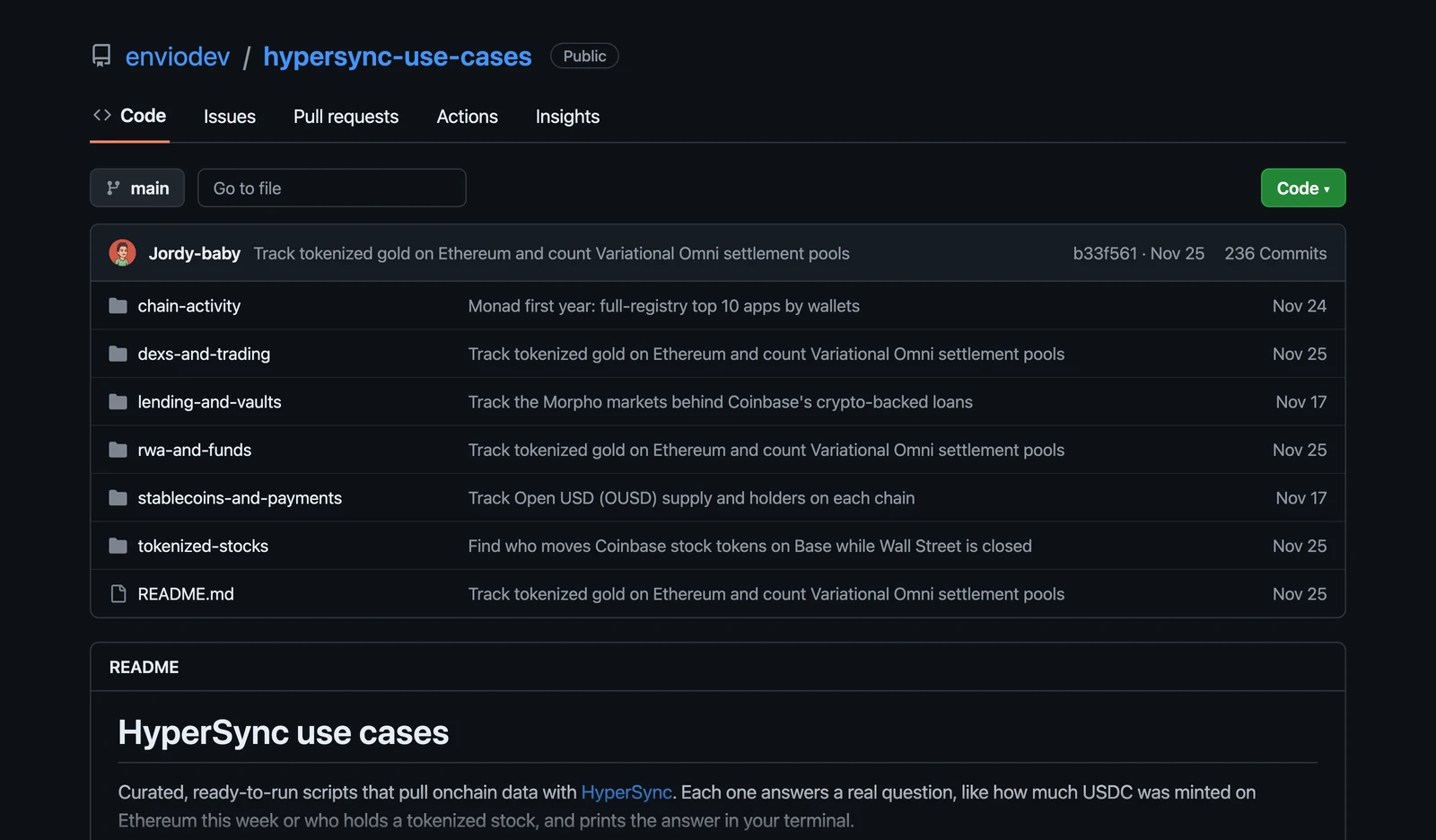
We have two public repos of ready-to-run examples you can copy and adapt, one for [HyperSync](https://docs.envio.dev/docs/HyperSync/overview) and one for HyperIndex.
[hypersync-use-cases](https://github.com/enviodev/hypersync-use-cases) has more than 70 HyperSync scripts, each answering a real question, like how much USDC was minted on Ethereum this week or who holds a tokenised stock. They cover stablecoins, tokenised stocks, tokenised funds, lending and more across Ethereum, Base, Arbitrum, Monad, Arc, Robinhood Chain, HyperEVM, Solana and other chains. Each one is plain Python with no dependencies, and most come with a README on what we found and how to check the numbers, plus a prompt you can paste into your coding agent to point it at your own contract or chain.
For example, when claims started landing on Uniswap's 2020 airdrop contract again, we followed them with HyperSync and watched over 28K claims pull more than 11.5M UNI out. [The script is public](https://github.com/enviodev/uni-airdrop-claims) if you want to check it.
[hyperindex-use-cases](https://github.com/enviodev/hyperindex-use-cases) is for when you need the data live behind an API. Its HyperIndex indexers keep the data up to date as new blocks arrive and serve it over GraphQL.
## MIP-16 Query Methods on HyperRPC
[HyperRPC](https://docs.envio.dev/docs/HyperRPC/overview-hyperrpc) now serves three of the MIP-16 query methods on every network it supports. They filter on the server, return only the fields you select, and can join related objects, such as each log's transaction and block.
| Method | Filters | Status |
| --- | --- | --- |
| `eth_queryBlocks` | `miner` | Live |
| `eth_queryTransactions` | `from`, `to`, function `selector` | Live |
| `eth_queryLogs` | `address`, `topics` | Live |
| `eth_queryTraces` | | Coming soon |
| `eth_queryTransfers` | | Coming soon |
The live methods work on mainnets and testnets alike, on the same endpoint you already use for standard methods, with a HyperRPC API token.
[Read the MIP-16 docs](https://docs.envio.dev/docs/HyperRPC/mip-16)
## Running Envio in Production
### The Reliability Suite Now Has 50 Checks
The reliability suite in our open indexer benchmark now has 50 checks, up from 44, across crash recovery, reorgs, RPC faults, data fidelity and head latency, and Envio Indexer passes all 50.
Each one runs against a generated chain and is described in the repo, so [you can run them yourself](https://github.com/enviodev/open-indexer-benchmark/blob/main/reliability/README.md) and check our numbers.
### Change Environment Variables Without a Redeploy
You can now change a running [Envio Cloud](https://docs.envio.dev/docs/HyperIndex/hosted-service) deployment's environment variables without redeploying or re-indexing. Open the deployment's Settings page, add, change or remove variables, and review the change before it's applied. The indexer restarts with the new values and carries on from where it left off, and the GraphQL endpoint stays available. This isn't available on the Development plan.
From the terminal, `envio-cloud` 1.2.0 adds [`deployment env` commands](https://docs.envio.dev/docs/HyperIndex/envio-cloud-cli#manage-a-deployments-environment-variables) to list, set and delete a deployment's variables and check the status of a change.
[More in the docs](https://docs.envio.dev/docs/HyperIndex/hosted-service-deployment#changing-environment-variables-of-a-running-deployment)
### A New Status Page
When an indexer stalls, the first question is usually whether it's your code or something else. Our [new status page](https://envio.dev/status) helps you answer that. It lists each HyperSync chain we monitor by EU and US region, next to the Envio Cloud dashboard, API, builds, deployments and indexer endpoints, each with its daily uptime history. Sign in to get alerts by email, Slack, Discord or Telegram for the chains and services you choose, or follow the Atom feed of incidents and maintenance.
## How HyperSync Runs on Bare Metal
HyperSync serves billions of blockchain queries, and our US and Tokyo regions run on [Cherry Servers](https://www.cherryservers.com) bare metal. Serving full chain history at that scale needs fast NVMe on dedicated hardware close to our users, and when we added the Tokyo region, Cherry had new servers up quickly.
[Read the full case study](https://www.cherryservers.com/case-studies/envio).
## Envio in the Circle Alliance Directory
We're proud to be a Circle Alliance partner. If you're building with stablecoins, our [Circle Alliance Directory profile](https://partners.circle.com/partner/envio) shows what teams can do with Envio, from monitoring transfers and tracking blacklisted addresses to treasury and settlement data. It also covers our support for Arc.
## Best Use of Envio at Monad Metropolis

Two very different builds took our Best Use of Envio prize at [Monad Metropolis](https://monad.xyz/developers/hackathons/metropolis), Monad's global hackathon. Congratulations to both:
- **[jagomoko](https://x.com/jagomoko)**, by [@0xsuntheluck](https://x.com/0xsuntheluck), splits every stream tip automatically onchain. HyperIndex turns each tip, vote and quest into the live activity feed that drives the stream overlay.
- **Sigilo**, by [@bitfalt](https://x.com/bitfalt), is private payroll on Monad. Its Envio indexer plays the attacker, measuring what the public record could reveal about who got paid what, so the team can prove the privacy holds.
[See the winners announcement](https://x.com/envio_indexer/status/2120563140148506684).
## How We Built a Solana Dashboard for IslandDAO V5
We were at [IslandDAO V5](https://islanddao.org/events/v5-brazil-2026) in Florianópolis, where registration, passes and daily check-ins all ran on Solana. So we built a dashboard on top of them with [HyperIndex on Solana](https://docs.envio.dev/docs/HyperIndex/solana). It has an island calendar, a leaderboard, event analytics and a passport for every islander, covering more than 800 check-ins from over 150 people.
The fun part was the check-in program itself. It has no published IDL, so we used HyperSync to pull its full onchain history and decoded it from there.
[See the indexer and dashboard code](https://github.com/enviodev/envio-islanddao-demo).
## Envio at Devcon and Solana Breakpoint
[Video: Nobody Verifies What Your Agent Reads, Denham Preen at Devcon 8](https://www.youtube.com/watch?v=BjH7oFY6DFA)
How far can you trust the chain data an AI agent reads? Our co-founder Denham Preen took that on in a Devcon lightning talk, ["Nobody Verifies What Your Agent Reads"](https://archive.devcon.org/devcon8/nobody-verifies-what-your-agent-reads/). Raw chain data can be verified, but values an indexer computes are harder to prove, and Denham talked through a design for tackling that.
The team was in Mumbai for [Devcon](https://devcon.org/) and in London for [Solana Breakpoint](https://solana.com/breakpoint). Thanks to everyone who stopped to chat.
## Featured Developer: Filippo Fontana
This month's featured developer is Filippo Fontana, who builds data infrastructure for [Centrifuge](https://centrifuge.io), the real-world asset protocol, as Managing Partner at [EMBRIO.tech](https://www.embrio.tech), a Zurich-based cloud-native software engineering studio. Filippo focuses on distributed systems, cloud infrastructure and production Web3 data pipelines, and leads the architecture and delivery of indexing and backend infrastructure for DeFi and real-world asset protocols. He's also a HyperIndex contributor.
**What Filippo had to say about Envio:**
> ***"We use Envio's HyperIndex for our production multi-chain indexing workloads. Compared to previous-generation indexers, the backfill speed makes a massive difference. It lets us iterate, test schema changes, and ship updates to our data ingestion pipelines much faster without waiting hours or days for historical re-syncs. Beyond the tooling itself, having a team we can rely on really matters. Their release speed and consistency directly help our own operational efficiency, infrastructure costs, and data quality."***
*- Filippo Fontana, [Centrifuge](https://centrifuge.io) (Managing Partner at EMBRIO.tech)*
Thank you, Filippo. Follow his work on [GitHub](https://github.com/filo87).
## Playlist of the Month

[Open Spotify](https://open.spotify.com/playlist/1n41voWpenZ4AOH3xNgm1C)
## Build With Envio
Envio builds custom blockchain APIs and analytics. Teams use it to turn smart contract activity into real-time APIs, to pull raw onchain data into their own pipelines, and to run it all on managed infrastructure, from a free plan up to Dedicated deployments with an SLA.
For onchain data findings, product releases and how teams use Envio in production, subscribe to the monthly newsletter, follow us on X or join our Discord.
[Subscribe to our newsletter](https://envio.beehiiv.com/subscribe?utm_source=envio.beehiiv.com&utm_medium=newsletter&utm_campaign=new-post)
[Website](https://envio.dev/) | [X](https://twitter.com/envio_indexer) | [Discord](https://discord.gg/envio) | [Telegram](https://t.me/+BeS5ihVUFONjNGFk) | [GitHub](https://github.com/enviodev) | [YouTube](https://www.youtube.com/channel/UCR7nZ2yzEtc5SZNM0dhrkhA) | [Reddit](https://www.reddit.com/user/Envio_indexer)