Agentic Blockchain Indexing: How to Deploy an EVM Indexer to Envio's Hosted Service
Agentic development works best when an AI agent can take a single prompt and run with it, end-to-end, without handing back to a human at every step. For blockchain indexing, that's exactly what we've built at Envio.
With Envio's hosted service CLI (envio-hs) and HyperIndex, an agent can scaffold a production-ready indexer, configure it for any EVM-compatible chain, push it to GitHub, and deploy it to Envio's hosted service, without a human ever touching a config file.
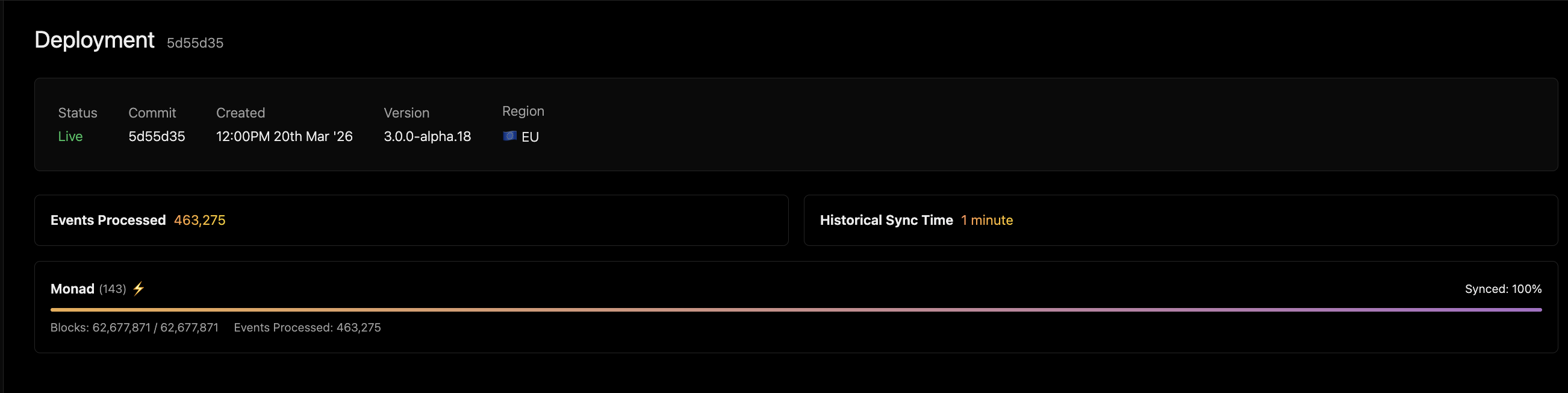
⚡ The result: 400,000 events indexed in ~20 seconds
What is HyperIndex?
HyperIndex is Envio's high-performance blockchain indexing framework. It's designed to make indexing fast to build and even faster to run, with support for EVM-compatible networks and a developer experience built around real workflows.
HyperIndex is the default indexing framework for agentic development with Envio’s hosted service CLI tool and comprehensive Claude skills. That means when an AI agent needs to spin up a blockchain data pipeline, HyperIndex is the go-to solution.
The Hosted Service CLI: envio-hs
The envio-hs CLI is the command-line interface for Envio's hosted service, the managed infrastructure layer that runs your HyperIndex indexers in production.
With it you can:
- Authenticate via GitHub (
envio-hs login) - Register a new indexer pointing to your GitHub repo (
envio-hs indexer add) - Monitor sync progress and deployment status in real-time (
envio-hs deployment status,envio-hs deployment metrics) - Promote deployments to production (
envio-hs deployment promote) - Pull JSON output for any command (
-o json), making it fully scriptable and agent-friendly
⭐ No dashboard required. Everything that matters is exposed through the CLI.
End-to-End: Agentic deployment of a wstETH indexer on Monad
Here's the full workflow an agent ran to deploy a live ERC20 indexer for wstETH on Monad Mainnet, start to finish.
Step 1: Scaffold the indexer
pnpx envio@3.0.0-alpha.18 init template -t erc20 -l typescript -d ./my-indexer --api-token ""
The envio CLI scaffolds a TypeScript ERC20 indexer template. No API token is needed at this stage as authentication is handled through the hosted service at deployment time.
Step 2: Configure for Monad
The agent edits config.yaml to target the wstETH contract on Monad Mainnet (chain ID 143, contract address 0x10Aeaf63194db8d453d4D85a06E5eFE1dd0b5417, start_block: 0).
Then runs codegen and a type check to confirm everything is clean:
pnpm codegen
pnpm tsc --noEmit
Note: the ERC20 template test file references a different contract address and network, so any resulting type errors need to be fixed before the type check passes.
Step 3: Push to GitHub
Create a public repo and push:
gh repo create wsteth-monad-indexer-demo --public
git init && git add . && git commit -m "init"
git push -u origin main
If the push fails due to the .github/workflows/test.yaml file and OAuth scope limitations, remove that file and push again.
The Envio hosted service deploys from the envio branch by default, so create and push it:
git checkout -b envio && git push -u origin envio
Step 4: Connect the Envio GitHub Bot
The Envio GitHub App must have access to the repo before deployments will trigger. If the repo is not already linked, visit:
https://github.com/apps/envio-deployments/installations/select_target
Then grant the bot access to the wsteth-monad-indexer-demo repository.
Step 5: Deploy
pnpx envio-hs login
pnpx envio-hs indexer add
  --name wsteth-monad-indexer-demo
  --repo wsteth-monad-indexer-demo
  --description "wstETH ERC20 indexer on Monad"
  --branch envio
  --skip-repo-check
  --yes
Step 6: Verify
pnpx envio-hs indexer get wsteth-monad-indexer-demo {org}
pnpx envio-hs deployment status wsteth-monad-indexer-demo <commit-hash> {org}
Once synced, the indexer is viewable in the browser at https://envio.dev/app/{org}/{indexer-name}/{commit-hash}.
Check the live deployment from this demo here: https://envio.dev/app/denhampreen/wsteth-monad-indexer-demo/5d55d35
⚡400,000 events indexed. ~20 seconds
See the full walkthrough on Loom, covering the complete agent driven workflow from scaffold to deployment.
Why this matters for agentic development
The blockchain data layer has historically been one of the friction points in agentic workflows. Spinning up an indexer meant reading docs, manually editing configs, managing infrastructure, and waiting for sync.
HyperIndex and the envio-hs CLI change that equation. Every step in the workflow above is scriptable, CLI-driven, and designed to be executed by an agent without human intervention. The JSON output flag (-o json) makes it straightforward to pipe deployment status into downstream logic. The GitHub-native deployment flow means agents that can commit code can deploy indexers.
This is what it looks like in practice for HyperIndex to be the default indexing framework for agentic development.
Getting started
Install the hosted service CLI:
npm install -g envio-hs
Scaffold your first indexer:
pnpx envio@3.0.0-alpha.18 init template -t erc20 -l typescript -d ./my-indexer --api-token ""
Whether you're building on Monad, Ethereum, or any other EVM compatible network, Envio enables agent driven indexing from first prompt to live deployment. The GitHub-native deployment flow means agents that can commit code can deploy indexers in minutes.
MCP loading.
About the Envio’s Hosted Service
Envio Hosted Service is a managed environment for running HyperIndex indexers in production.
It handles infrastructure, scaling, and monitoring, so indexers can run reliably without managing operational overhead. Multiple plans are available, from free development environments to dedicated production deployments, each with features such as static endpoints, built in alerts, and production ready infrastructure.
Build With Envio
Envio is the fastest independently benchmarked EVM blockchain indexer for querying real-time and historical data. If you are building onchain and need indexing that keeps up with your chain, check out the docs, run the benchmarks yourself, and come talk to us about your data needs.
Stay tuned for more updates by subscribing to our newsletter, following us on X, or hopping into our Discord.
Website | X | Discord | Telegram | GitHub | YouTube | Reddit