Envio Developer Update July 2026
 Jordyn Laurier
July was a big month for HyperIndex. Four releases took it from v3.2.1 to v3.4.0, built around huge multichain and factory contract indexers, unlimited onEvent handlers, per-chain effect caching, and a testing framework that runs 12x faster. We also published the largest public Polymarket dataset ever released, 2.74 billion onchain records free under CC-BY, and began previewing Envio Analytics, an alpha that puts natural-language querying and generated dashboards on top of indexed data.
Alongside that, Solana indexing landed at the instruction level, three new showcase apps went live covering tokenised stocks, Solana DEX activity and Safe multisigs, and we launched a new changelog so every release is tracked in one place.
Let's dive in!
HyperIndex v3.4.0 & v3.3.0
Four releases this month, from v3.3.0 through to v3.4.0. The theme was scale: large multichain and factory contract indexers, more control over caching and storage, and a much faster feedback loop during development.
v3.4.0
Unlimited onEvent Handlers
Previously only a single onEvent handler was allowed per event definition, which made it impossible to run different handlers with different filters against the same event. Since v3.4.0 there is no such restriction, so you can handle every ERC20 Transfer in one handler and a USDC-only slice in another.
import { indexer } from "envio";

// Track all ERC20 Transfers
indexer.onEvent(
  { contract: "ERC20", event: "Transfer", wildcard: true },
  async ({ event, context }) => {},
);

// And a separate handler for USDC-only is also possible
indexer.onEvent(
  { contract: "ERC20", event: "Transfer", wildcard: true, where: {
      params: [
        { from: USDC_ADDRESS },
        { to: USDC_ADDRESS },
      ],
    },
  },
  async ({ event, context }) => {},
);

// And contractRegister can have a different `where` filter for the same event
indexer.contractRegister(
  { contract: "ERC20", event: "Transfer", wildcard: false /* non-wildcard for contract register */ },
  async ({ event, context }) => {},
);
Note that this can result in a single log being processed by different handlers and counted as multiple events in the metric. The same log execution is guaranteed to follow handler registration order inside a file.
Per-Entity ClickHouse Tuning
Set partitioning, ordering, and TTL on an entity through the @storage directive, so your analytic queries run faster.
type Transfer @storage(clickhouse: {
  partitionBy: "toYYYYMM(timestamp)",
  orderBy: ["timestamp"],
  ttl: "timestamp + INTERVAL 2 YEAR"
}) {
  id: ID!
  timestamp: Timestamp!
}
Reach out to us for ClickHouse support on Envio Cloud.
Test Indexer Got 12x Faster
The v3 testing framework now runs as fast as it did before the v3 upgrade, with all the new v3 features on top.
Indexer tests are now 12x faster.
If your setup or your agents are not using it yet, the Testing Guide is the place to start.
v3.3.1
v3.3.1 added an indexer-local-parallel skill for running multiple indexers locally without collisions, along with reorg threshold handling for indexers with 10M+ addresses, ClickHouse initialisation in replicated mode, and wildcard events always firing a handler even when the same log is consumed by another non-wildcard event.
v3.3.0
v3.3.0 is built for huge multichain and factory contract indexers, with faster backfill, lower memory usage, better stability, and lower latency at the head.
Per-Chain Effect API
The Effect API takes a new crossChain option, which controls whether an effect's input is cached and rate-limited globally or separately per chain. It defaults to true, a single shared cache across every chain, which suits chain-agnostic calls like token metadata or price by symbol. Set it to false and each chain gets its own cache and rate-limit budget, with context.chain.id available in the effect handler.
// Chain-specific result → crossChain: false, access context.chain.id
const getBalance = createEffect(
  {
    name: "getBalance",
    input: S.string,
    output: S.bigint,
    rateLimit: false,
    crossChain: false,
  },
  async ({ input: account, context }) =>
    rpcFor(context.chain.id).getBalance(account),
);
Cross-chain effects can only call other cross-chain effects, since they have no specific chain context, while chain-scoped effects can call either type. Be aware that per-chain effects use a different cache structure, so switching the option requires a cache reset or migration.
Read more in the Effect API docs.
Custom HTTP Headers For RPC
Authenticated RPC endpoints now come straight from your config, so bearer tokens and provider auth live alongside everything else with env var interpolation.
chains:
  - id: 1
    rpc:
      - url: https://eth-mainnet.your-rpc-provider.com
        for: sync
        headers:
          authorization: "Bearer ${ENVIO_RPC_1_TOKEN}"
RPC Source Enhancements
The RPC source picked up two capabilities previously only possible with HyperSync: event handlers using an or union for params filters in where, and indexers running multiple wildcard events. We also improved how the RPC source handles a provider's response-too-large errors.
Nested Env Vars Interpolation In Config
Environment variable interpolation now supports nested fallback values in defaults, so a default can itself reference another environment variable.
See the full release notes
Star us on GitHub
The Largest Public Polymarket Dataset Ever Released
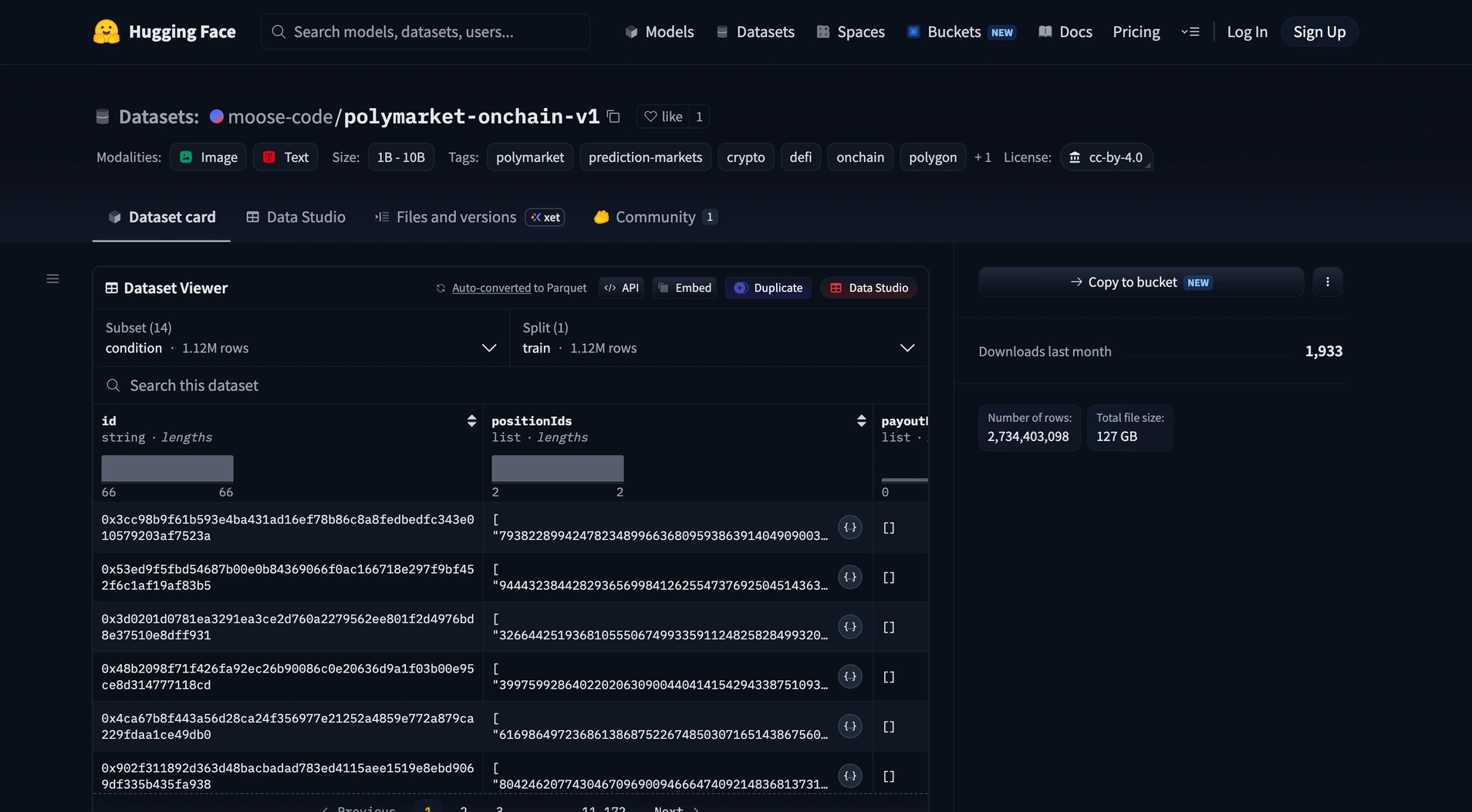
We released the complete onchain Polymarket dataset on Hugging Face, free under CC-BY-4.0. It covers every trade, position and payout from the 2020 launch through April 2026, indexed straight off Polygon with HyperIndex.
Most Polymarket datasets stop at trades. This one carries the entire onchain lifecycle, every CLOB fill plus every conditional-token split, merge, redemption and resolution, all the way back to the 2020 AMM era. That is what lets you reconstruct real positions, realised PnL, and exactly who got paid when a market resolved. You can query the whole thing from your terminal with DuckDB without downloading a single file, because it pulls only the byte ranges it needs.
2.74 billion records, 1.17 billion CLOB trades, $59.9B in lifetime volume, and 2.63 million trader wallets, across 127GB of Parquet.
None of it is a black box. The open-source indexers that produced it are public, so every number is reproducible from scratch.
Explore the dataset here: Polymarket onchain dataset on Hugging Face
For a step-by-step walkthrough with DuckDB queries, see How to Get Polymarket Trade Data.
Envio Analytics, Now in Alpha
An indexer already holds some of the richest, most structured data about a protocol. Once that foundation exists, the next step is making the data easier to explore, question and understand.
We are experimenting with a new analytics feature that combines HyperIndex, ClickHouse as an analytical data store, natural-language querying, and automatically generated charts and dashboards. Co-founder Denham shared a demo interacting with more than 2 billion indexed Polymarket events, asking a simple question: which FIFA World Cup markets have been traded most actively?
The feature is still very much in alpha, but the underlying idea is a powerful one. High-quality indexed data can become an interactive analytics layer for every protocol.
Indexing Solana at the Instruction Level
HyperIndex now indexes Solana programs at the instruction level. You select the programs and instructions you care about, and HyperIndex decodes them, arguments and accounts, using your Anchor IDL or an inline schema, then writes the results to Postgres with an auto-generated GraphQL API.
Inner instructions (CPIs), token balances and balance changes, transaction metadata and program logs are all available. It is powered by HyperSync for Solana, the same data engine behind our EVM indexing, so historical backfills are fast and you never touch an RPC node for the bulk of indexing. Solana support is still experimental and TypeScript-only, and it is a good time to help shape it, so come and say hello on Discord if you are building there.
Read the docs: Solana indexing with HyperIndex
Robinhood's Tokenised Stocks Live on v4.xyz

Tokenised stocks issued by Robinhood trade around the clock as Uniswap v4 pools, and you can now watch them live at v4.xyz/stocks. GME, NVDA and TSLA are priced from onchain swaps, with volume, TVL and trade counts per stock.
30,771 trades in a single 24 hour window.
v4.xyz is the central hub for exploring Uniswap V4 hook deployments, pool data and onchain analytics, powered by HyperIndex across 15 chains. The indexer behind it is open source and open to contributions, so you can index Robinhood stocks and much more yourself.
Check it out on GitHub: the open source Uniswap v4 indexer
More on the showcase page: v4.xyz on the Envio showcase
Envio vs The Graph
A sourced, head-to-head comparison of the two, covering sync speed, handler language, multichain support and reorg handling, then what switching actually involves.
Sync speed is the clearest gap. In the independent Sentio Uniswap V2 Factory benchmark, HyperIndex finished in 8 seconds against 19 minutes for The Graph. On the Sentio LBTC workload it finished in 3 minutes against 3 hours 9 minutes.
142x faster on the Sentio Uniswap V2 Factory workload.
Full methodology is on our benchmarks page, with the raw runs in the open-indexer-benchmark repo.
Read the comparison: Envio vs The Graph
SolSwaps, a Firehose of Solana DEX Activity

No RPC, no archive node, no database. SolSwaps streams every DEX swap on Solana into a single live view, covering the network's busiest venues including Jupiter, Pump.fun, Orca and Raydium.
The dashboard tracks swaps per second, estimated SOL moved, aggregated fees, and a running list of the 25 biggest trades as they land, giving traders, researchers and builders a fast picture of where volume is flowing across Solana. It is built entirely on HyperSync, with no infrastructure for you to run.
See it live: SolSwaps on the Envio showcase
How to Stream Onchain Events to an AI Trading Agent
Building an AI trading agent? The interesting question is not the model, it is the feed.
An agent needs onchain events fast, structured, and correct through reorgs, and raw RPC gives you none of that out of the box. This guide shows how to wire HyperIndex in as the feed layer, with the schema, queries and reorg handling taken from the published Polymarket reference indexer. It also covers the part that matters most for anything moving money: head-of-chain state is provisional, so act on events from finalised blocks.
Read the full tutorial: How to stream onchain events to an AI trading agent
Safescan, One Explorer for Every Safe
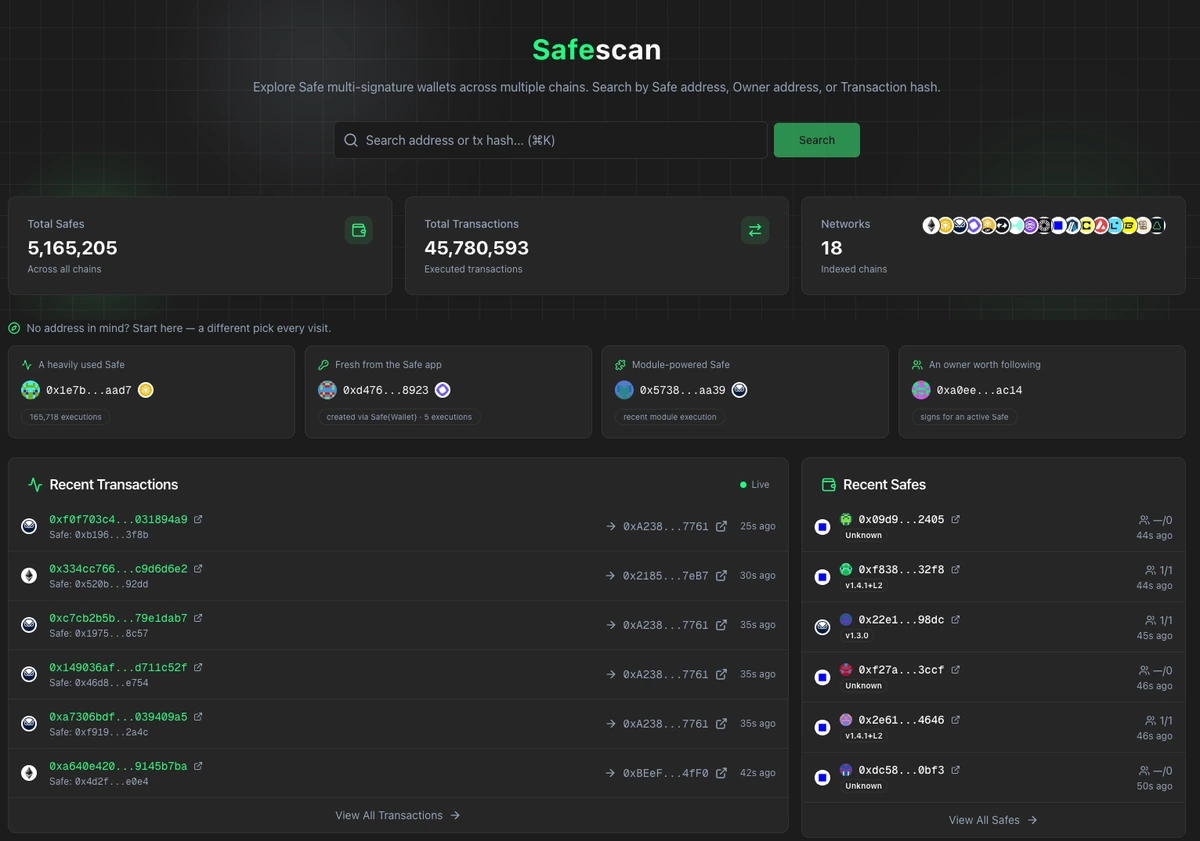
Safescan is a multichain explorer purpose-built for Safe multisig wallets. Search by safe address, owner address or transaction hash, and watch creations, proposals, confirmations and executions land live.
Powered by HyperIndex, it indexes Safe wallet creation events, transaction proposals, confirmations and executions across 18 chains in real time and aggregates them into a single interface. At the time of writing it covers more than 5.1 million Safes and 45.7 million executed transactions.
Explore it here: Safescan on the Envio showcase
How to Build an Open Source RWA Stablecoin Dashboard
One event type, all your stablecoin metrics. Total supply, transfer count, transfer amount and volume, mint and burn amounts, and daily snapshots of each, all derived from Transfer events, since mints and burns show up as transfers to and from the zero address. USDT is the exception, so the indexer reads its Issue and Redeem events directly.
The dashboard is backed by a HyperIndex indexer you can run yourself, and the whole thing is open source. Fork it and build your own.
More here: How to build an open source RWA stablecoin dashboard
A New Changelog Page

Our new changelog is live. Every HyperIndex release, feature, fix and improvement is now tracked in one place, so you can see what changed and when without digging through release tags.
Take a look: the Envio changelog
Wildcard Indexing and Topic Filtering
Index every ERC20 Transfer onchain without a single contract address. Wildcard indexing matches events by signature rather than by address, so you can capture events from factory-deployed contracts, or from every contract implementing a standard.
Add topic filtering on top to keep only the events you actually want. Both work on HyperSync and RPC.
Learn more here: Wildcard indexing and topic filtering
Stargate's Bus Routes, Visualised

Co-founder Jonjon shared a real-time visual of all the "bus routes" on Stargate Finance, powered by Envio, with Base and Arbitrum comfortably the busiest route.
The distinction it makes visible is a neat one. A taxi transfer leaves immediately, while a bus transfer waits at a stop on the source chain until other transfers board alongside it.
Plans, Pricing and Educational Discounts

Envio Cloud runs your indexer without you touching infrastructure, from a free Development plan, to Production with static endpoints and zero-downtime deploys, to Dedicated for unlimited scale and a custom SLA.
We also offer educational discounts for students, academic researchers and educational institutions, available for university courses, academic research and non-commercial student projects. Eligibility is verified with a valid academic email or proof of enrolment, and the discount depends on your use case and project scope. Reach out to the team to apply.
For more information, see our pricing page.
Migrating From The Graph Without a Rewrite
Migrating a subgraph to HyperIndex does not mean starting over. AssemblyScript is a subset of TypeScript, so your event parsing and business logic copy across verbatim, and what changes is mostly the wiring rather than the code doing the work.
Three things change in a well-defined way: subgraph.yaml becomes config.yaml, your schema sheds the @entity decorator, and handlers swap Entity.save() for context.Entity.set() with async/await. Existing subgraph queries keep working through our query converter, and the Indexer Migration Validator diffs entity state between both endpoints before you cut over.
See the side-by-side migration: the drop-in subgraph replacement walkthrough
Featured Developer: Geauser

This month's featured developer is Geauser, a developer and founder currently working on Umi, a beginner-friendly web-based NFT minting bot. He describes himself as having a renaissance profile, touching a bit of everything rather than just NFTs, though NFTs are where the focus sits right now, and he has been building on HyperSync for around a year and a half.
What Geauser had to say about Envio:
"I've been using HyperSync from Envio for almost a year and a half now. It basically solves all my "what happened in the past" problems. What makes HyperSync so great is that I can ask those questions and get answers in milliseconds or seconds rather than minutes. It lets me drastically optimise Umi and run historical analysis across multiple chains without worrying about running my own indexer or dealing with slow archival RPCs that have limited query capabilities. One example: sometimes I need to know if a user minted a particular NFT in a given phase, so I can decide whether to let them mint another one if the collection allows it. With HyperSync, I can check that, in a few hundred milliseconds, which makes my code much cleaner. On top of that, it has wide chain support, so it's perfect for a multichain product like mine. It also lets me run historical analysis, like how Umi performed during a given mint. It's an incredible tool, and I couldn't recommend it enough. You can be sure I'll use Envio in my next ventures as well."
Well done, Geauser. Be sure to follow him on X and check out his GitHub to stay up to date with his latest developments.
Playlist of the Month

Build With Envio
Envio is a multichain EVM blockchain indexer for querying real-time and historical data. If you're working on a Web3 project and want a smoother development process, Envio's got your back(end). Check out our docs, join the community, and let's talk about your data needs.
Stay tuned for more monthly updates by subscribing to our newsletter, following us on X, or hopping into our Discord for more up-to-date information.
Website | X | Discord | Telegram | GitHub | YouTube | Reddit