Envio Developer Update October 2026
 Jordyn Laurier
Envio Indexer passed all 44 checks in the new reliability suite of our open indexer benchmark, including all 16 RPC fault checks, with no data lost and nothing counted twice.
HyperIndex v3.14.0 adds a new terminal UI built in Rust, lets you add a chain to an indexer that is already running, and type-checks handlers before the indexer starts. We also rebuilt the docs for coding agents and made Migrate Using AI scaffold the project for you.
HyperIndex v3.14.0
This release focuses on running indexers day to day, with a clearer view of sync progress, fewer restarts and type errors caught before production.
Highlights
- A new terminal UI, built in Rust and run on its own thread
- Add a new chain to a running indexer without re-indexing the others
- Handlers are type-checked when you run
envio startorenvio dev - pnpm 11 support out of the box
- HyperSync support for developers building on Somnia
HyperIndex v3.14.0: A Rust Terminal UI and Chains Added Without a Restart
A New Terminal UI, Built in Rust
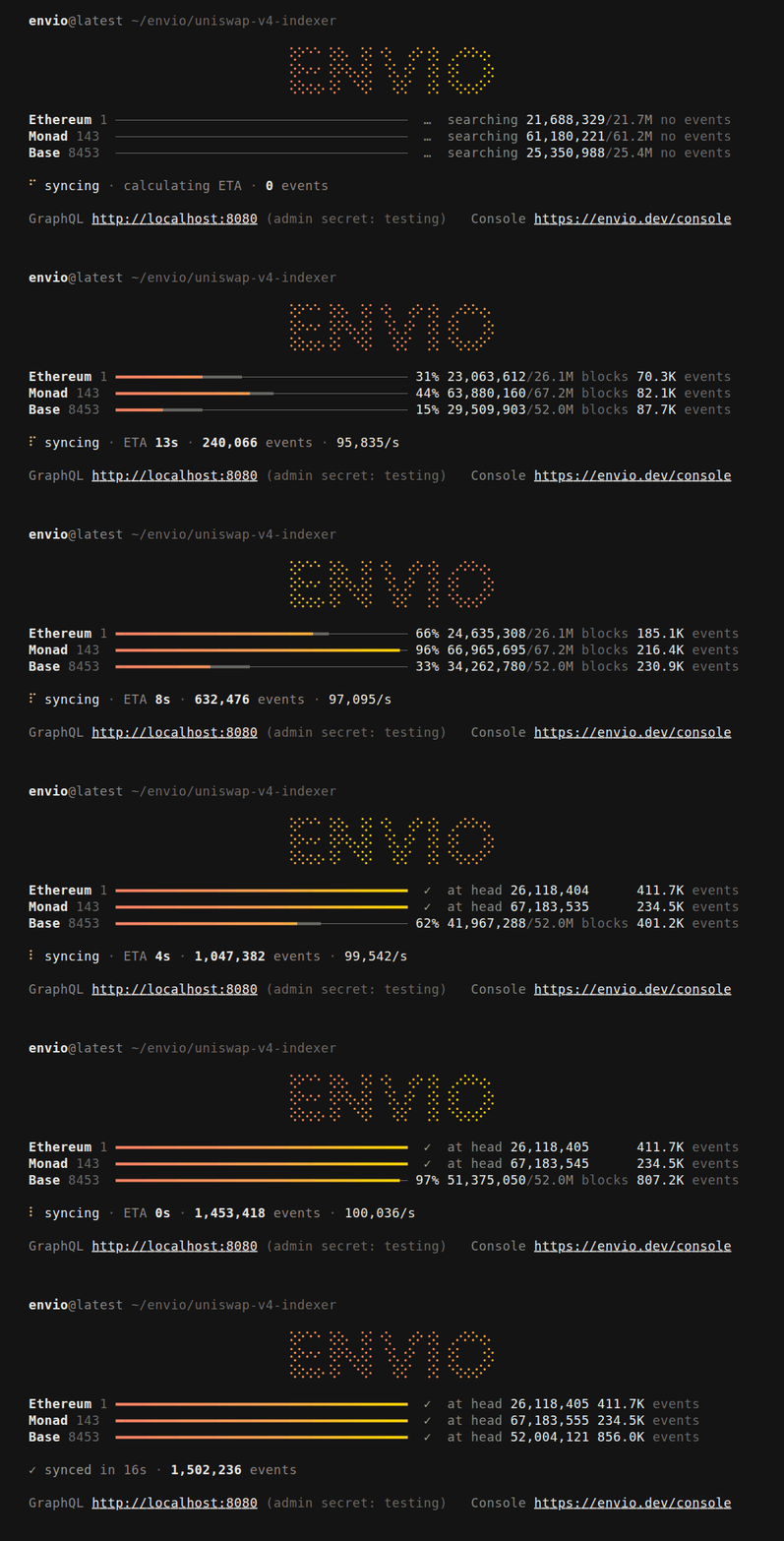
Running an indexer locally now comes with a new terminal UI. We rebuilt it in Rust and moved it onto its own thread, separate from the indexer, so it stays responsive while your chains sync.
It also means the envio package no longer depends on ink, ink-big-text, ink-spinner, react, @rescript/react or date-fns, so installs are lighter.
Add a New Chain to a Running Indexer
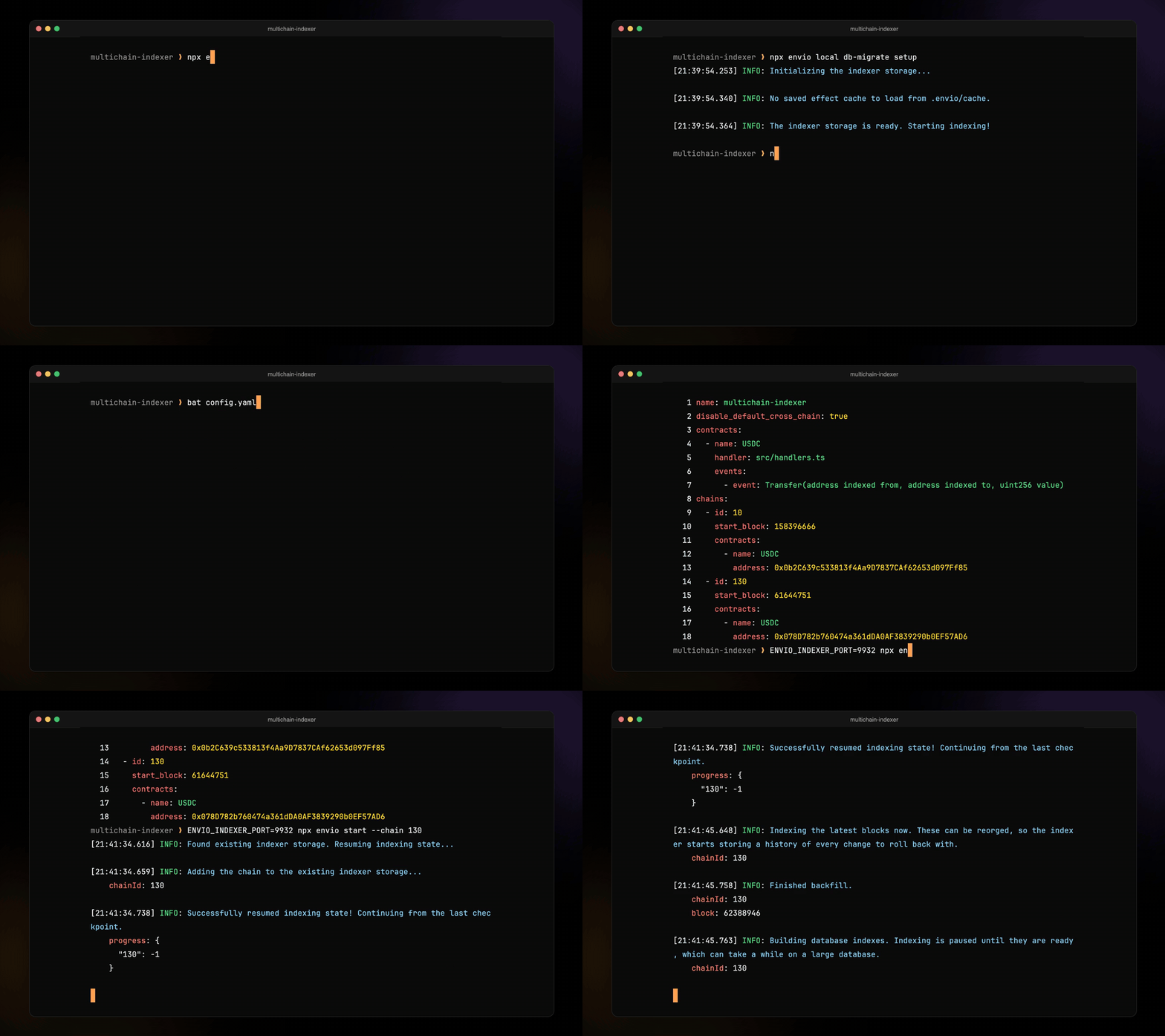
Chain 130 is added to config.yaml and started in its own process with envio start --chain 130, against the same database as chain 10.
If you self-host and run your indexer in multi-process mode, you can now add a chain to the database it already writes to. Add the chain to config.yaml, plus any handler files it needs, then start it in its own process with its own port:
ENVIO_INDEXER_PORT=<free-port> envio start --chain <new-chain-id>
Each process needs a separate ENVIO_INDEXER_PORT. HyperIndex migrates the database to include the new chain and starts indexing it, while the chains you already have keep going.
This works when every entity is configured to be per chain.
Breaking: Handlers Are Type-Checked on Start
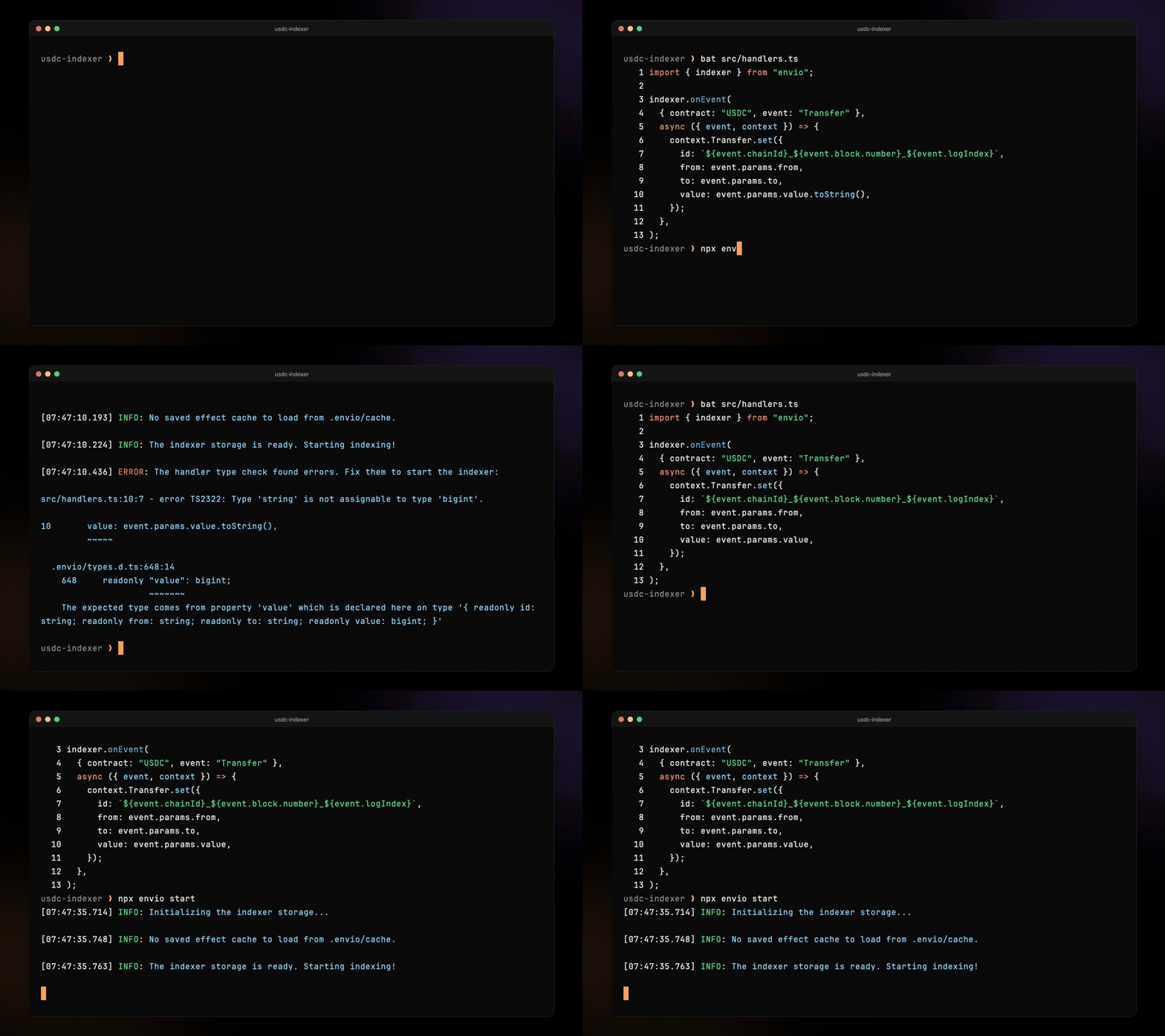
HyperIndex now type-checks your handler files when you run envio start or envio dev. A type error stops the indexer before it runs, instead of turning up later in production, and you get the feedback sooner while developing.
This can stop indexers that ran before with type errors in their handlers. The minimum supported Node.js version also moves from 22.0 to 22.15.
To upgrade with a coding agent, paste this prompt into it from your indexer's folder:
Upgrade prompt for your coding agent
Upgrade this HyperIndex indexer to the latest envio release. First run
node --version and stop to tell me if it is below 22.15, since that is
now the minimum. Check the envio version in package.json and stop if it
is below 3, since that needs the v3 migration guide. Install envio@latest
with this project's package manager. Run the project's TypeScript check
(for example npx tsc --noEmit) and fix any type errors in the handlers
without changing what they index. Then run envio dev once to confirm it
starts, and stop it with Ctrl+C. Do not run envio stop or envio dev -r,
because they delete the local database. Summarise each fix you made.
pnpm 11 Support
The envio package no longer depends on tsx, so it works with pnpm 11 without allowing packages with build scripts. Error messages for handlers with invalid syntax are also clearer.
Somnia and Faster Decoding
We added HyperSync support for developers building on Somnia. Fuel log decoding is now written in Rust, which removes five @fuel-ts dependencies, and params decoding is faster on EVM, SVM and Fuel. JSON entity fields are now typed as JSON.
Also in v3.14.1
rpc.url in config.yaml now accepts an optional ${RPC_URL:-}, a source that hits a stale replica gets about 10 seconds before it fails over on both HyperSync and RPC, and handlers are type-checked with your project's own tsc, so TypeScript 7 works. It also brought our first contribution from @sakulstra. Thank you.
See full release notes
Star us on GitHub
Envio Indexer Passes All 44 Reliability Checks
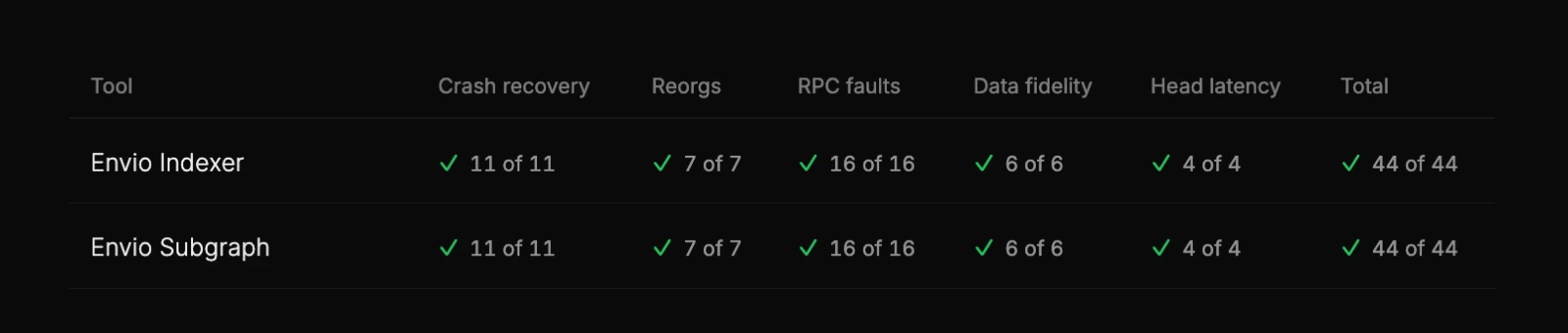
Our open indexer benchmark now has a reliability suite. It runs each indexer against a generated chain, introduces crashes, reorgs and RPC faults, and checks the database afterwards. The RPC fault checks use a node that errors, rate limits, stalls, drops connections and returns conflicting data.
Envio Indexer passed all 44 checks across crash recovery, reorgs, RPC faults, data fidelity and head latency. In the head latency test, a new block took a median of under 10ms to become readable.
For teams running in production, this is the part of indexing that is hardest to test before going live. Missing or duplicated rows rarely show up as errors, so the suite checks the data itself. The generated chain makes every fault repeatable, every check is described in the repo, and you can run it yourself.
Built to Keep Running in Production
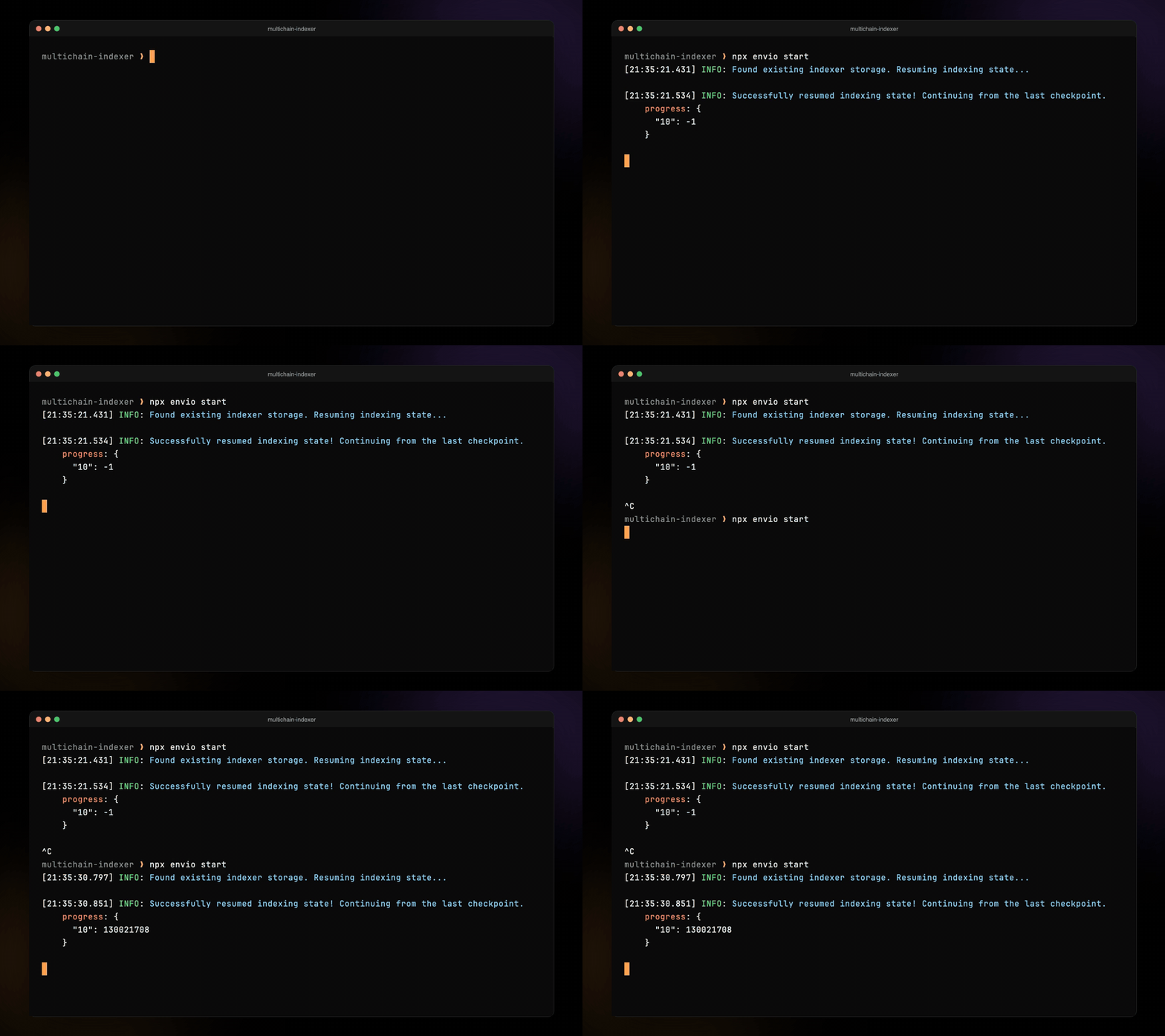
The indexer is stopped with Ctrl+C and started again. It resumes from its last saved checkpoint, block 130,021,708.
Our production reliability guide now answers the questions teams ask before they go live, and covers how HyperIndex keeps indexed data correct and private.
You can add fallback RPC sources, and HyperIndex switches over when the primary stops returning new blocks, then tries the primary again 60 seconds later. Progress is saved in the database, so a restart picks up from the last saved point rather than the start block. Each batch is written in a single database transaction, so a crash never leaves half-written data. On Envio Cloud paid plans you can protect an endpoint with API keys, IP whitelisting or both.
How to Index Somnia Blockchain Data
You can index contracts on Somnia with Envio. You write an indexer with HyperIndex, our indexing framework, and it pulls Somnia's blockchain data from HyperSync, our data API, so there's no RPC endpoint to set up.
Somnia's developer docs now include a tutorial, Indexing Somnia with Envio. It indexes every USDC.e transfer on Somnia Mainnet, runs the indexer locally and queries the data with GraphQL, then shows how to move an existing subgraph to HyperIndex. It also includes a prompt for doing the steps with a coding agent.
Envio Docs, Built for Coding Agents
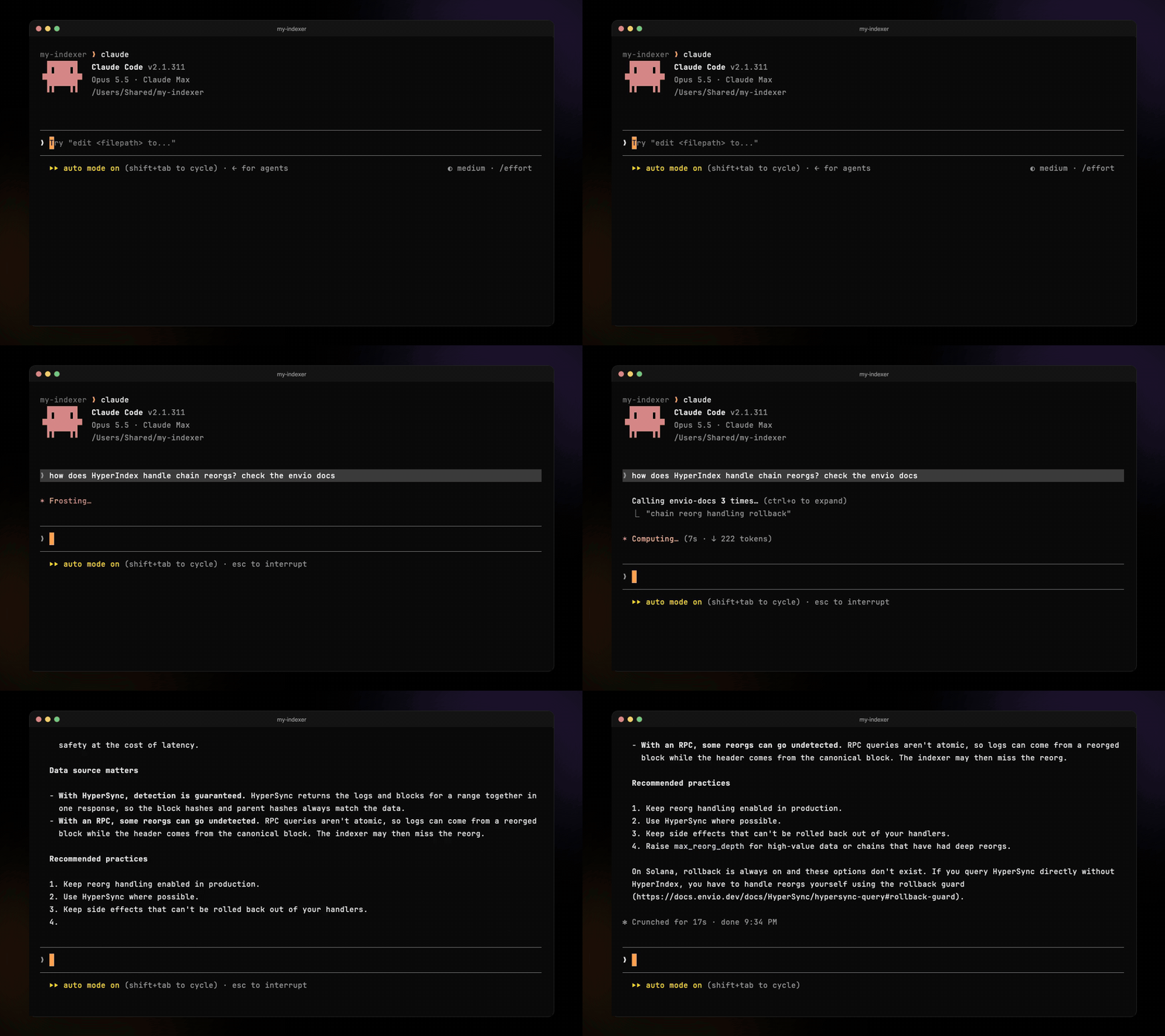
Many developers now ask a coding agent about Envio before they open the docs, so we built the docs to work well for agents:
llms.txtis a short guide that tells an agent where to start.- Each product has its own context file, kept under 50k tokens so it fits in an agent's context.
- The full docs file starts with HyperIndex.
- Every page is available as clean markdown.
The MCP server and the envio tools search-docs command find the answer to all 21 test questions taken from real user issues. In the recording above, Claude Code answers a question about reorg handling by searching our docs over MCP.
To give Claude Code the docs over MCP:
claude mcp add --transport http envio-docs https://docs.envio.dev/mcp
Which Envio Product Fits Each Data Job
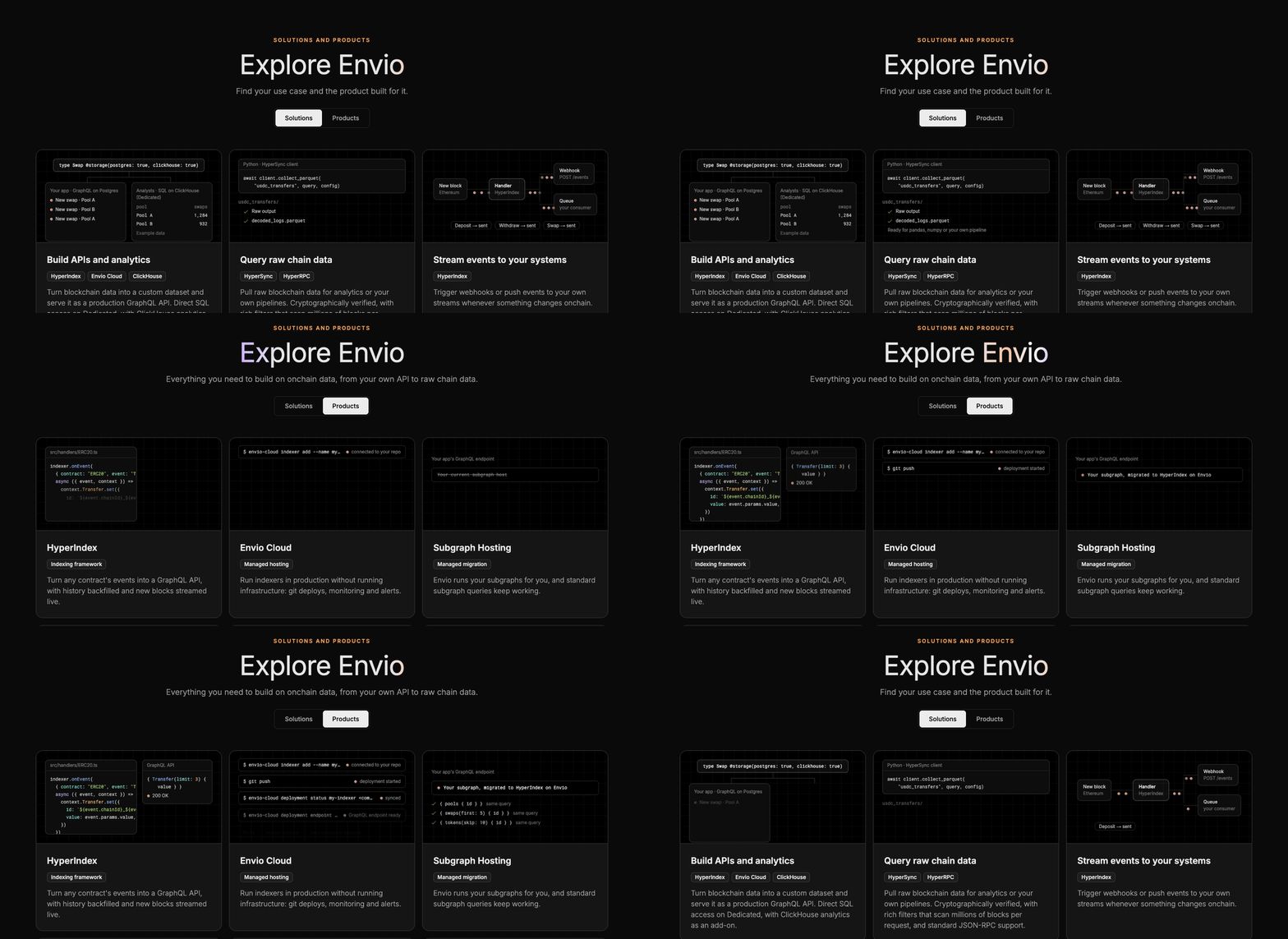
Envio is now organised around the jobs teams bring to us, and the product built for each one.
- Build APIs and analytics with HyperIndex and Envio Cloud. Turn contract activity into a custom dataset served as a GraphQL API, with direct SQL access on Dedicated and ClickHouse analytics as an add-on.
- Query raw chain data with HyperSync and HyperRPC, for analytics or your own pipelines.
- Stream events to your systems with HyperIndex, by triggering webhooks or pushing to your own streams when something changes onchain.
- Give AI agents onchain data with HyperIndex and HyperSync.
- Migrate your subgraphs with Subgraph Hosting or HyperIndex.
For enterprise teams, that comes with multi-region infrastructure, including the US, EU and Japan, an SLA of up to 99.99% and direct access to our engineers.
Explore our products and solutions
Subgraph Migrations, Scaffolded by Your Coding Agent
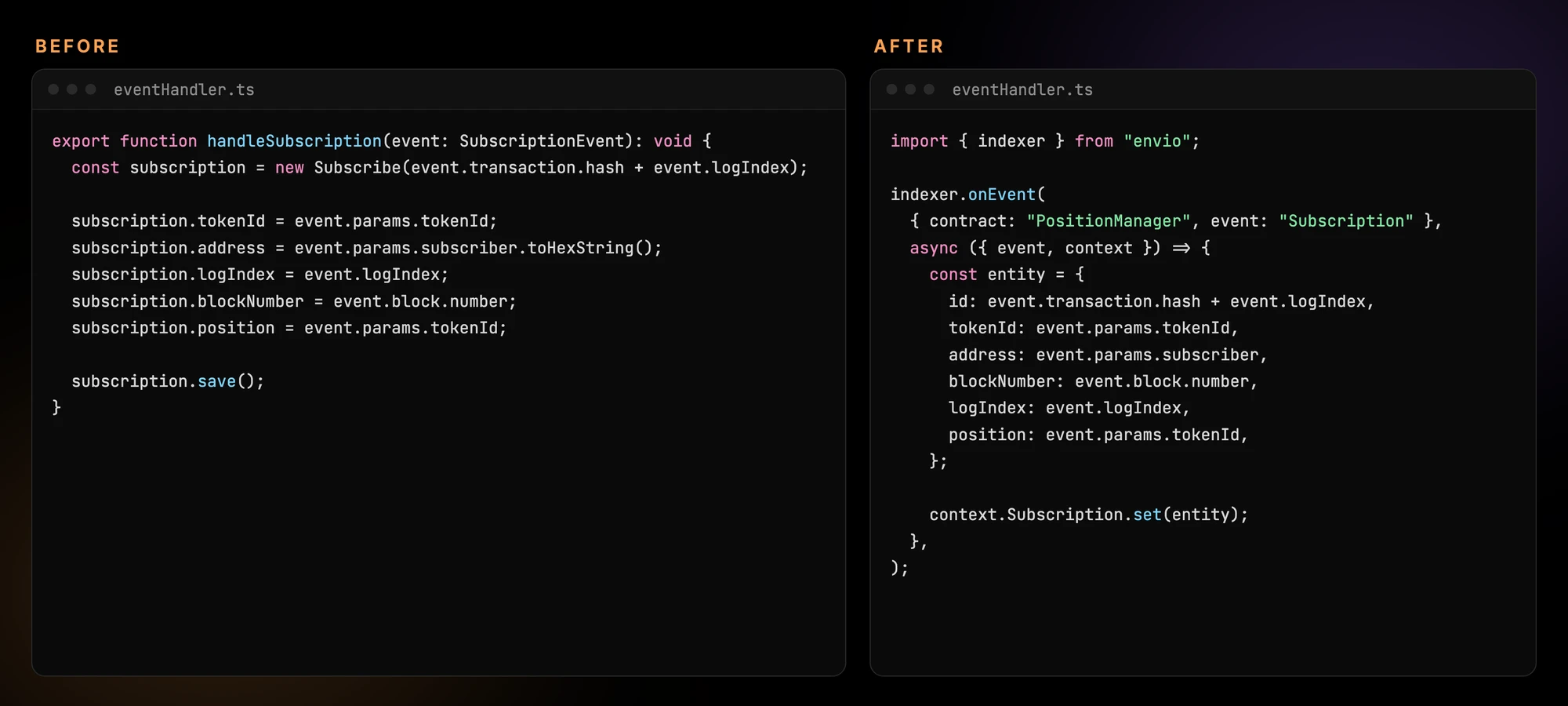
The same Subscription handler as a subgraph mapping and as a HyperIndex handler, from our migration guide.
Migrate Using AI now scaffolds the HyperIndex project for you. Open your coding agent in an empty folder, paste the prompt, and point it at your existing indexer, such as a subgraph, by local path or git URL. The agent picks one contract on one chain, scaffolds it with envio init, matches config.yaml to your existing indexer and runs codegen, then ports your logic.
Set your API token in the shell you start your agent from, and envio init saves it to the new indexer's .env:
export ENVIO_API_TOKEN=<your-token>
There's no need to run envio init or set up a repo yourself first. HyperIndex projects also include 17 agent skills that teach your coding agent how to write config, schema, handlers and tests.
40 Runnable HyperSync Examples
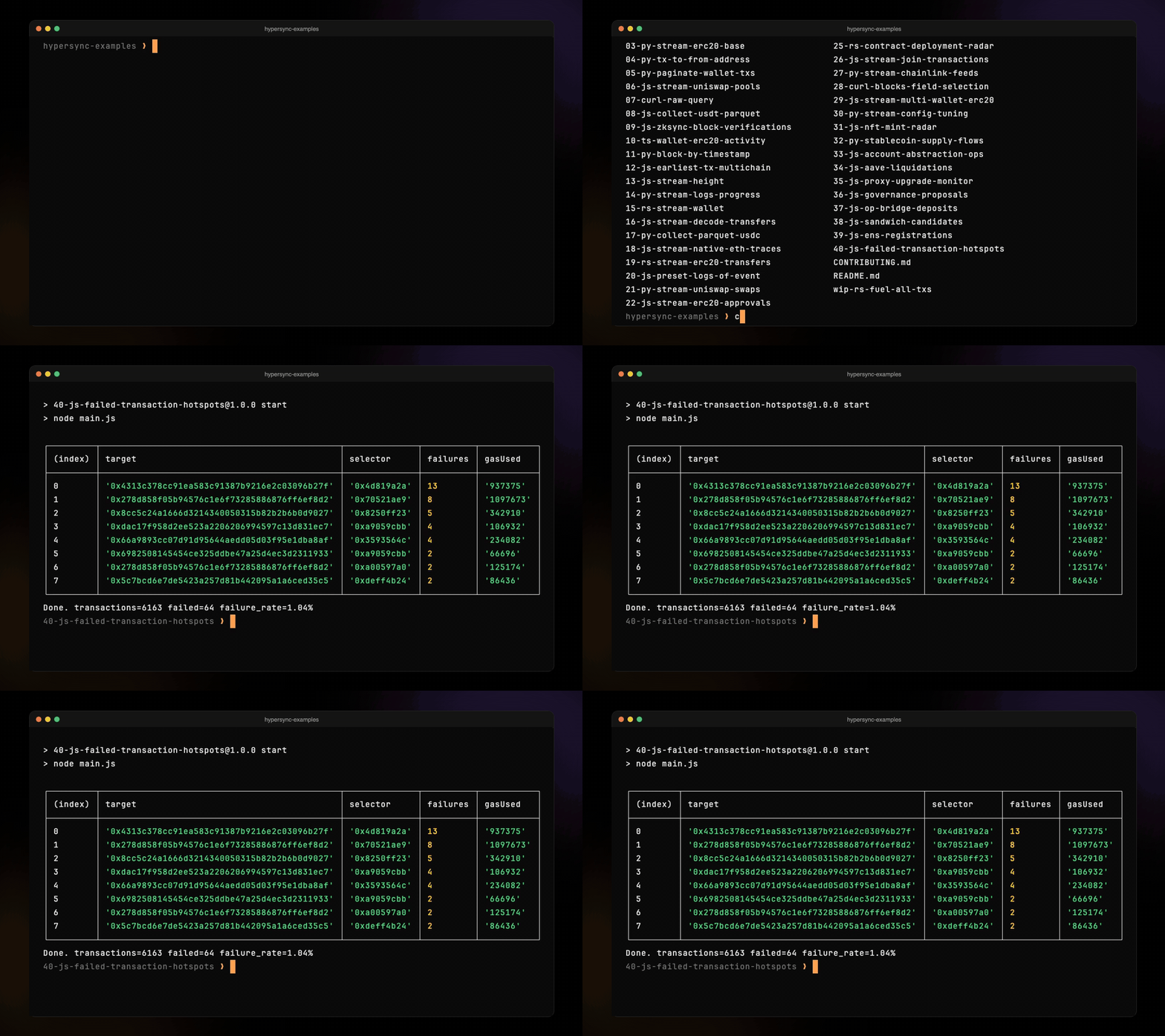
Example 40 scans the 25 most recent confirmed Ethereum blocks and ranks the contracts and function selectors with the most failed calls. In this run it found 64 failures in 6,163 transactions.
To see what HyperSync can do before you build anything, our examples repo has 40 runnable examples in Python, JavaScript, TypeScript, Rust and curl.
They go from the basics, like paginating a wallet's transactions or finding a block by timestamp, to full feeds for Aave liquidations, NFT mints, governance proposals and proxy upgrades, plus a stablecoin supply tracker and a sandwich candidate finder.
Prompt for your coding agent
Clone https://github.com/enviodev/hypersync-examples and run example
40-js-failed-transaction-hotspots. Follow that example's README: run
npm install, make sure ENVIO_API_TOKEN is set in my environment (ask me
for it if it is not, and never print it), then run npm start. When it
finishes, explain the table it printed and which contracts and function
selectors had the most failed calls.
New in the Docs

1. API tokens, step by step
The API tokens page is now a set of numbered steps that match the dashboard, with walkthrough GIFs for creating a token, having envio init write it to .env, and checking usage. Read the page
2. Billing FAQ
The pricing and billing page now answers 10 common questions, from when you're charged to how HyperSync overage works. Read the FAQ
3. Envio Cloud troubleshooting
New answers cover schema errors, codegen failing on Envio Cloud, deploying an older commit and builds that time out. Read the page
4. Choosing an RPC provider
For EVM chains HyperSync doesn't cover, the RPC docs now explain how to pick a provider, with Dwellir and eRPC as options. Read the page
5. One version of the docs
We removed the HyperIndex v2 docs. Every old v2 link redirects to the same page in the v3 docs, and the migration guide is there for anyone still on v2.
Current & Upcoming Events & Hackathons
- Devcon 8 - Mumbai: November 3rd -> 6th
- Solana Breakpoint - London: November 15th -> 17th
Featured Developer: François-Julien Alcaraz
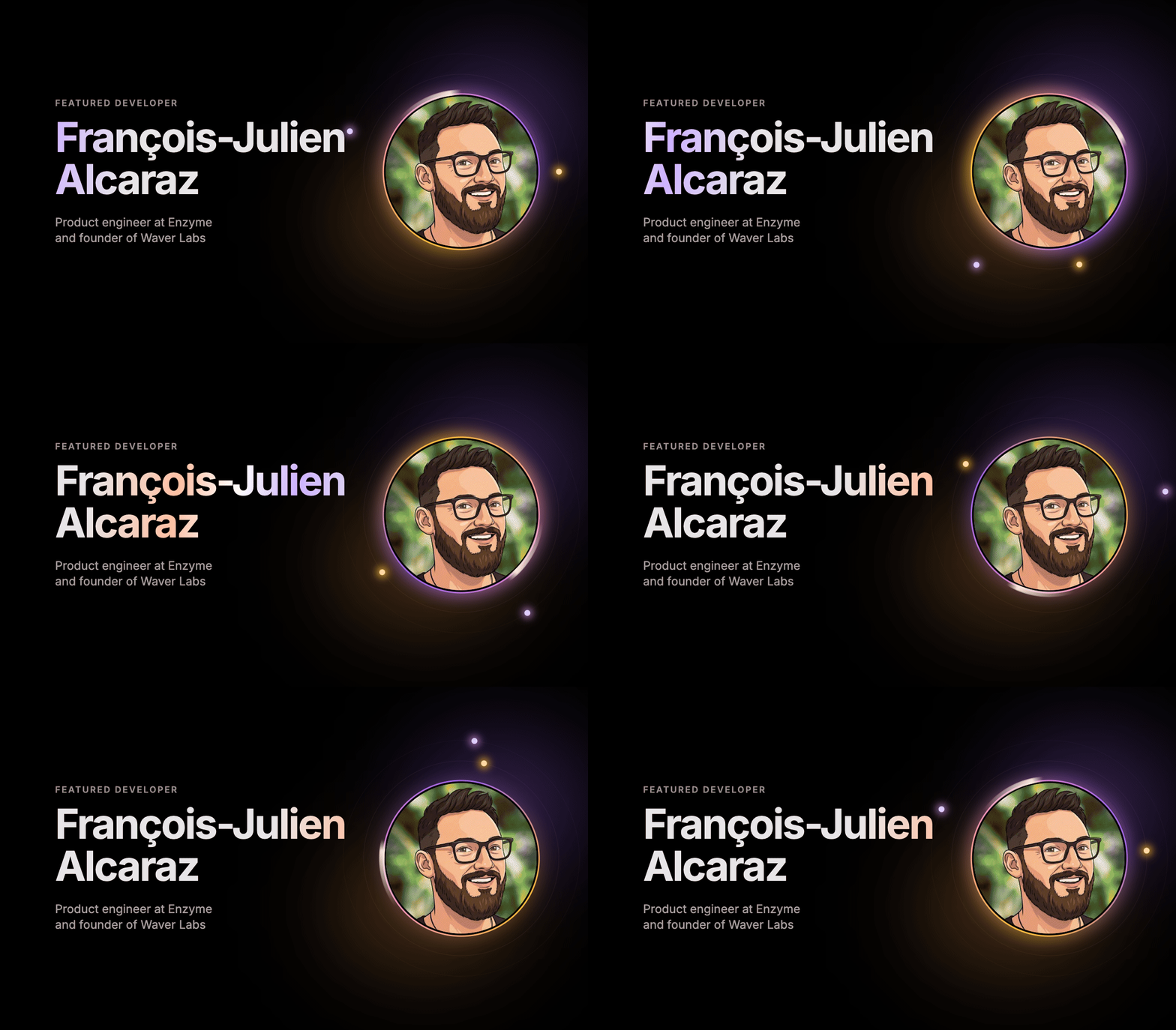
This month's featured developer is François-Julien Alcaraz, a product engineer at Enzyme and the founder of Waver Labs. Enzyme provides infrastructure for creating and managing tokenised financial products onchain, used by product issuers, portfolio managers and builders. We really appreciate the detailed issues and feedback François-Julien has shared with our team.
What François-Julien had to say about Envio:
"We migrated from Ponder to Envio and it's been way faster. The team has been really responsive, and we've been very happy with the move."
- François-Julien Alcaraz, Product Engineer at Enzyme
Connect with François-Julien on LinkedIn and follow their work on GitHub.
Playlist of the Month

Build With Envio
Envio builds custom blockchain APIs and analytics. Teams use it to turn smart contract activity into real-time APIs, to pull raw onchain data into their own pipelines, and to run it all on managed infrastructure, from a free plan up to Dedicated deployments with an SLA.
For onchain data findings, product releases and how teams use Envio in production, subscribe to the monthly newsletter, follow us on X or join our Discord.
Website | X | Discord | Telegram | GitHub | YouTube | Reddit